Israel’s War Budget Shows This Government Can’t Change
11/17/2023 12:32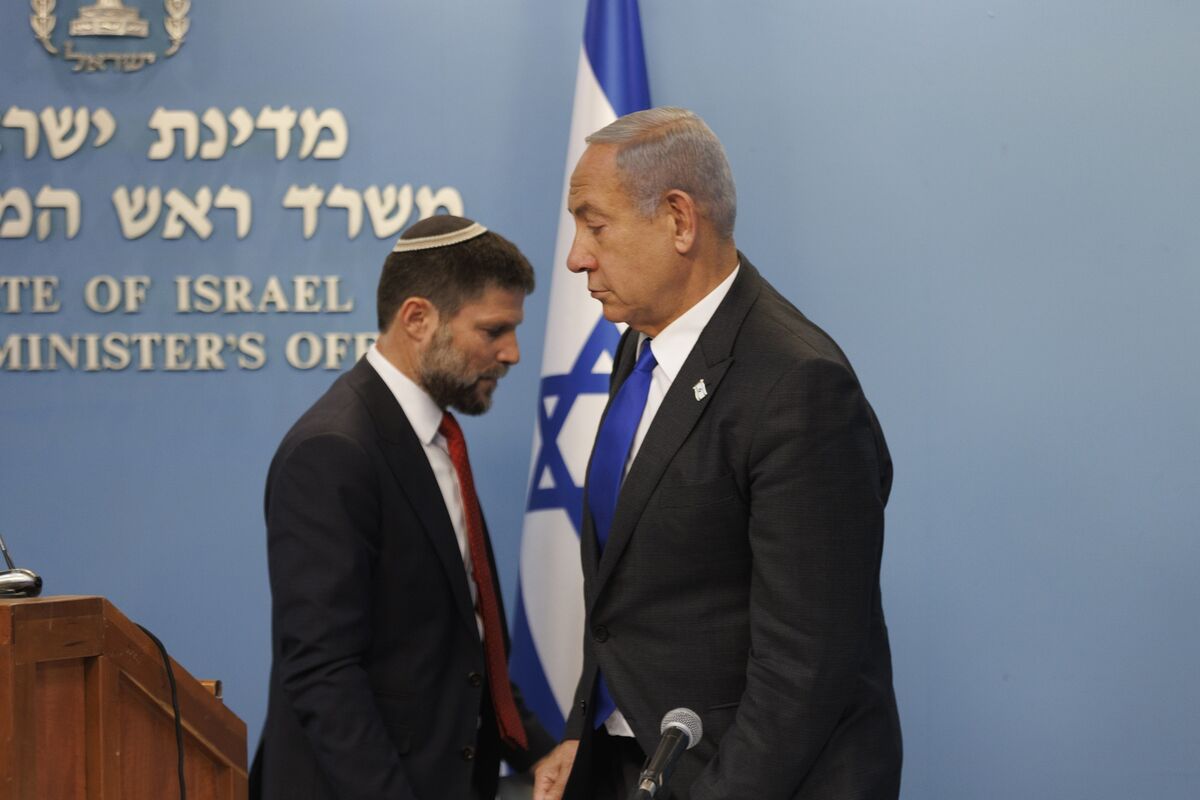
Diversion of funds to settlers, ultra-orthodox should be unacceptable.
Israel is a country at war, with its expenditures exploding, revenue reduced and borrowing costs on the rise. It’s also under growing international pressure to reconsider ideologically driven policies that lowered the nation’s guard against Hamas, a designated terrorist organization. So you’d think Finance Minister Bezalel Smotrich would be doing all he can to fix that.
Not so, according to the Bank of Israel’s head of research, who in a
statementon Wednesday said Smotrich’s proposed budget amendment to pay for the war would — if approved by the cabinet and parliament — do little to calm the market jitters that are driving up Israel’s cost of credit. Smotrich, the bank said, is proposing to add 31 billion shekels ($8.23 billion) of war-related expenditures to this year’s budget, while cutting other government spending by just 4 billion shekels to make room.
Israel’s central bank made clear it thought the spending cuts should be bigger and said where they should come from: the so-called coalition funds demanded by the union of far-right political parties that Smotrich represents in the government. These are newly super-sized state subsidies that support and protect Smotrich’s settler voters in the occupied West Bank, whose actions before Hamas’ Oct. 7 attack did so much to distract the attention of Israel’s security agencies away from Gaza. The money also pays for backers of his ultra-orthodox allies — already exempt from military service — not to have to work, so they can study the Torah unimpeded.
Still more goes to the private religious schools attended by the children of ultra-orthodox voters, where boys in particular get little education in the core subjects needed for employment. A
quarterof Jewish Israelis attend such schools, yet only 14% of them passed the state-wide high school matriculation exam in 2019, compared with 83% of students in non-religious schools.
If a forensic accountant were to look for ways to show where Israel has gone wrong in recent years, and why the current government is proving incapable of articulating an exit strategy for its war in Gaza, then the continued coalition funding in Smotrich’s budget proposals would be a good place to start. Funding new illegal settlements just isn't compatible with any feasible future for Gaza other than occupation.
It would be misleading, though, to pin all this on one personality or budget. Because, just as demographics define the challenges of finding an agreement with the Palestinians, so too are they changing the nature and political makeup of Jewish Israel in ways that have lifted hard-right politicians to prominence.
The much-derided two-state solution remains the only plan to end the decades old Israeli-Palestinian conflict that’s acceptable in diplomatic circles, because demographics make any realistic version of a single state a recipe for ethnic cleansing. In short, there are at least as many Palestinians and Arab Israelis as Jews living on the territories that would make up a unified state. This means that, absent ethnic cleansing to change the demographic balance, it’s hard to envisage how a Jewish-run state that includes Gaza and the West Bank could remain a democracy. And as much as we might wish for a Palestinian Switzerland, based around a shared Jerusalem, the long and current history of bloodshed makes that unlikely.
The judicial reforms of Prime Minister Benjamin Netanyahu’s government that dominated debate in Israel before Oct. 7 were already moving the country in an undemocratic direction. Meanwhile, his settlement policies and, since the war, the scale of destruction and comments from some government members have raised concerns over the potential for ethnic cleansing. One far-right Israeli cabinet minister was suspended for proposing to drop a nuclear bomb on Gaza, while Smotrich posted his support on Facebook, proposing “voluntary immigration of Gaza Arabs to the countries of the world.''
This shift has been made possible by changes in the Israeli electorate, where ultra-orthodox Jews make up by far the fastest-growing constituency. According to data sourced from the government for a series of
reportsby the Jerusalem-based Israel Democracy Institute, ultra-orthodox Israeli women had 6.5 live births on average in 2021, compared with 2.5 for other Jewish Israeli women. The community accounts for at least 13.3% of the population, up from 10% in 2009, and with 16% projected by 2030.