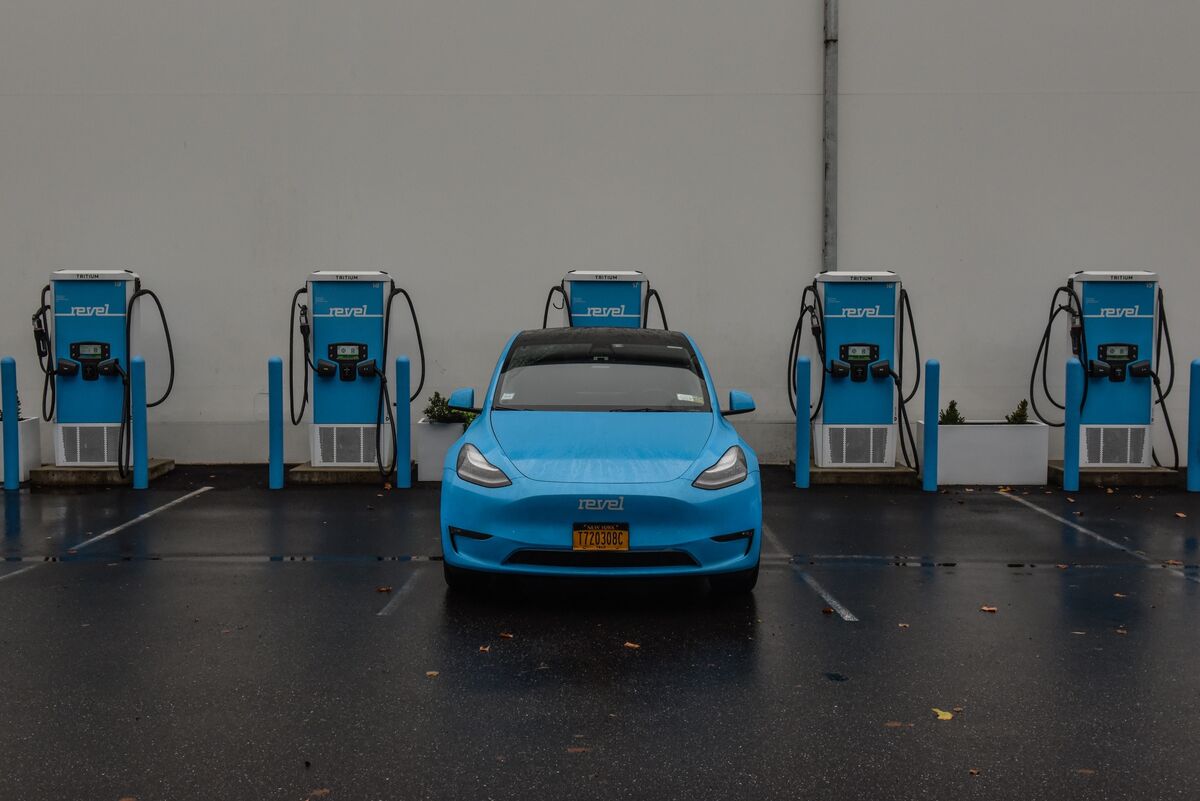
If governments want to diminish foreign influence over household budgets, they need to power up more robust charging networks.

David Fickling is a Bloomberg Opinion columnist covering energy and commodities. Previously, he worked for Bloomberg News, the Wall Street Journal and the Financial Times.
Not enough.
Photographer: Stephanie Keith/BloombergJust as battery-powered vehicles hit a tipping point where their cost plunges below that of conventional cars, a fresh hurdle risks holding back the EV revolution: charging networks.
The Biden administration’s $7.5 billion plan to build a chain of electric filling stations across the US has yet to connect a single socket, Politico reported last week. China, home to nearly two-thirds of the world’s public charging points, is still struggling to connect them in rural areas, making long cross-country drives in EVs an anxiety-inducing proposition.
Up Next
Fixing Our EV Charging Networks Is a National Security Issue